


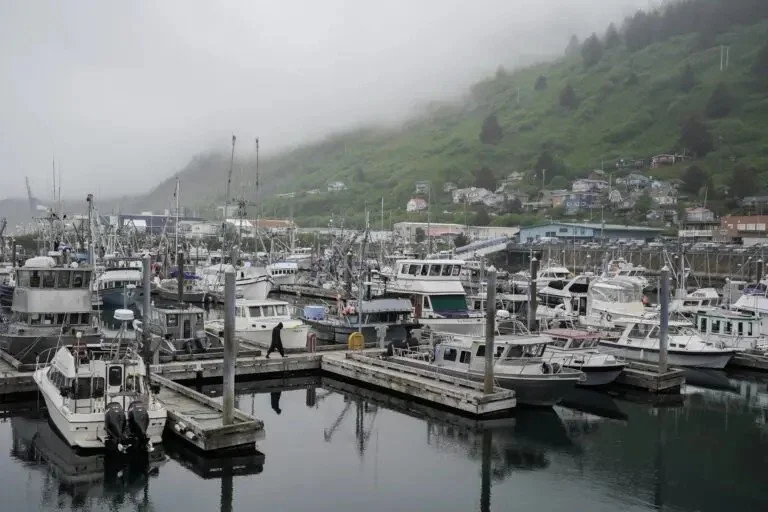
Photo from Alaska’s fishing industry pays a high price for the war in Iran | The Alaska Independent

Check out a recent conversation from KTOO's Juneau Afternoon show that aired on Thursday, June 11th, about our SeaBank Initiative and Report. Paul Olson (author) and Beth Short-Rhoads shared a sneak preview of the forthcoming SeaBank Report (SeaBank's 6th report) which digs deeper into Southeast Alaska's fish and wildlife species, and much more.
May 15, 2026
Good News Network
Andy Corbley
"A decade after Scotland banned bottom trawling and dredging there are flourishing populations of no less than 1,500 species critical for seabed integrity.
The news came via a survey which compared the South Arran Marine Protected Area with nearby fished zones, in which scientists identified twice as many species, and thrice as much abundance of life."
May 24, 2026
MSN
Lauren Owens Lambert and Leah Douglas
ALFA Executive Director Linda Behnken was featured in MSN's article "Fishing boats worldwide tuck dockside as diesel prices surge on Iran war"
"Fuel can account for as much as 40% of the expenses for a fishing trip, according to Linda Behnken, a fisherman in Sitka and executive director of the Alaska Longline Fishermen's Association.
"It went up over a dollar a gallon from one week to the next and right before everybody was filling up with full tanks to start the season," Behnken said. "That’s a really big impact on the cost of operation."
For now, the prices of halibut and sablefish, also known as black cod, are high enough that boats fishing for those species are still making regular trips, Behnken said. But when the less-profitable salmon season starts in July, diesel costs may be too high to justify leaving the dock, she said. "
WHY: This is the most important election for the fishing industry. It determines who makes decisions on and provides access to your fisheries. The next Governor of Alaska’s policies and appointments of ADF&G Commissioner, the Board of Fisheries, and the North Pacific Fishery Management Council are extremely important to the viability of commercial fisheries in Alaska.
***IF YOU WILL BE ON THE WATER FISHING, YOU NEED TO VOTE EARLY***
WHEN: The Primary Election for Alaska Governor is Tuesday, August 18, 2026, for in-person voters. The top four candidates who receive the most votes for Governor in the Primary advance to the General Election held on Tuesday, November 3, 2026.
Voter Registration Deadline: Sunday, July 19, 2026
Absentee By-Mail Request Deadline: Saturday, August 8, 2026
Absentee by Electronic Transmission Request Deadline: Monday, August 17, 2026
Absentee By-Mail Ballots must be postmarked or received by Tuesday, August 18, 2026
You can apply to vote absentee by-mail, fax, or online:
Online absentee ballot application here, you can select “All in Calendar Year” to receive ballots for all eligible elections.
WHO: There are 18 candidates; the following have expressed interest in resource development and the economic success of Alaska’s commercial fisheries.
Republican Click Bishop and Greta Schuerch
Former State of Alaska Senator (Fairbanks) and Dept of Labor Commissioner
‘I’ll focus on what matters most: ensuring good jobs are growing and Alaskans have the opportunity to thrive, no matter where they live. This includes lowering energy costs, prioritizing our fisheries, providing quality education opportunities, and strengthening our economy.’
‘Committed to protecting Alaska’s fisheries and supporting the fishermen and communities that depend on them, while preserving our coastal and river heritage, food security, and a cornerstone of our economy through sustainable, science-based management.’
Republican Matt Heilala
‘I started commercial fishing at age nine in Cook Inlet. By fourteen, I was fishing Bristol Bay, one of the most productive and demanding wild salmon fisheries on earth. By eighteen, I was a skipper. Fisheries aren't a policy position for me. They're my heritage, my livelihood, and part of who I am as an Alaskan.’
‘Government and industry must work hand-in-hand to protect our fisheries, and our fishing families:
Protect Alaska’s commercial fishing families and coastal communities
Smart, science-based fisheries management
Address bycatch through smart policies that minimize waste
Stand up for Alaska’s interests against outside pressure
Ensure fair access for all Alaskans, from Bristol Bay to Cook Inlet’
Democrat Matt Claman
Current State of Alaska Senator (Anchorage)
When appointing members to the Board of Fisheries, he intends to have a ‘balance that reflects commercial fishing interests, sport fishing interests, and also subsistence interests.’
Science-based decision making is a priority. Understands a stable regulatory environment is needed for small businesses, including fishing.
In his past work as an attorney has represented commercial fishermen.
Democrat Jonathan Kreiss-Tomkins
Former State of Alaska Representative (Sitka)
Fisheries priorities include: reining in bottom trawl bycatch, preventing commercial permits from leaving Alaska, restoring crashed Chinook runs in Yukon, Kuskokwim, and Southcentral Alaska, and increasing co-management of subsistence resources.
May 19, 2026
Wrangell Sentinel
Mary Catharine Martin
"Ten years ago, fish research biologist Ryan Bellmore assessed how many salmon the Tongass National Forest contributes to commercial fisheries. The number turned out to be huge — 75% of 50 million salmon caught commercially in Southeast Alaska each year.
“I started thinking about the way the forest provides a diversity of services to people. Humans are a part of the food web,” he said.
Until recently, however, there was no study quantifying just how much value wild foods provide to rural residents — or the importance of incorporating that value into land management. Two new studies shed light on those topics for southern coastal Alaska."
May 14, 2026
Chilkat Valley News
Will Steinfeld
The Chilkat Valley News recently interviewed Chandler Kemp about the F/V Mirage, one of the first commercial fishing vessel in the U.S. to fish using a battery‑electric/diesel hybrid system — developed through an ALFA pilot project.
Haines grad and UAF engineering professor Kemp helped design the system, which lets the Mirage haul gear and run at slow speeds on battery power, cutting fuel use and emissions while keeping the boat fully fishing‑ready.
"The State of Alaska and fishermen, Tlingit & Haida, and technical experts tell very different stories of B.C. transboundary mining at House State Affairs Committee hearing.
Alaskans testifying before the Alaska State Legislature House State Affairs Committee on Thursday, May 7th, agreed on an immediate need for greater State of Alaska transparency and engagement when it comes to transboundary rivers flowing from British Columbia into Southeast Alaska; a binding international agreement for Alaska and B.C.’s shared international rivers; and more. The Committee heard from the Central Council of Tlingit & Haida Indian Tribes of Alaska, Alaska Longline Fishermen’s Association, multiple nonprofits and the State of Alaska. The consensus came after testimony from Alaska Department of Fish and Game Commissioner Doug Vincent-Lang and Stephen Buckley of the Alaska Department of Natural Resources, in which Vincent-Lang excluded key, telling details on the state of B.C. mining activity in the headwaters of the Taku, Stikine, Unuk and Salmon Rivers."
May 12, 2026
Anchorage Daily News
By Kevin Whitworth and Craig Chythlook
"Community Development Quotas are frequently used as an argument for keeping the current system in place. CDQ income is not a replacement for subsistence, nor does its current structure provide an economically or ecologically sustainable industry in rural communities."
May 28, 2026
Alaska Daily News
Robert Wright, Kevin Whitworth, Barbara ‘Wáahlaal Gidaak Blake, Linda Behnken, Michelle Stratton and Lauren Hynes
For more than 30 years, pollock trawlers have dragged nets across Alaska’s seafloor in areas explicitly closed to bottom trawling. And regulators let them do it because their gear is classified as “midwater.”
The science no longer supports that classification. Despite being categorized as “midwater,” the pollock trawl fleet accounts for roughly 40% of all seafloor contact in the Bering Sea alone.
Bottom trawling is one of the most damaging types of fishing in the world, unquestionably harming the ecology of the ocean floor and ecosystem. Nets, rollers and metal components scrape along the seafloor, wiping out just about everything in the way. Long-lived corals and sea whips, crabs, halibut, salmon, and unlucky whales and seals can all get caught and killed in bottom trawl nets.